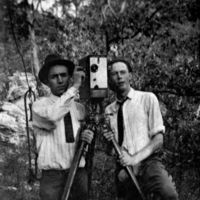
In late 1919, Walt Disney returned from his voluntary Red Cross service in post-World War I France. An independent eighteen-year-old, he’d resettled in Kansas City, Missouri and attempted to establish a career in illustration, graphic design, and cartooning. However, within a year’s time, a different art form caught his attention.
When the Disneyland television show premiered in October 1954, it promised stories and programs from four distinct lands in the still-under-construction theme park: Fantasyland, Adventureland, Frontierland, and Tomorrowland. With no existing library of material to populate the Tomorrowland segments, Walt assigned a team, directed by veteran animator Ward Kimball, to develop “science-factual” programs about human space exploration, among other topics.
Before hearing from the people who worked with Eric Larson, learn more about his life and career.
The roots of the Disney family tree begin in earnest in Normandy, France, and make stops in Ireland and Canada before Walt's father, Elias, is born.
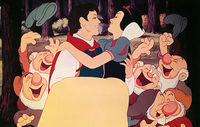
Of all the countless stories and anecdotes about Walt Disney, one of the most iconic and oft-recounted by those who knew him was of the fateful evening in the mid-1930s when Walt assembled his core group of artists in the sound stage at the Disney studio on Hyperion Avenue. There, without aid or introduction, Walt single-handedly performed the story of what would become Snow White and the Seven Dwarfs (1937).
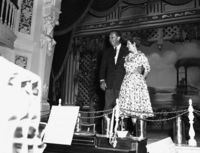
On July 13, 1955—four days before the grand opening of Disneyland—Walt and Lilly Disney were set to mark their 30th wedding anniversary. With showtime just around the corner, what better venue to host the celebrations than Walt’s new Park?
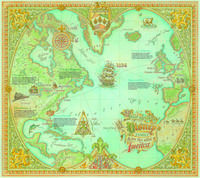
In late May 1957, American television viewers gathered for another weekly installment of the Disneyland program. Entitled “The Liberty Story,” Walt Disney greeted viewers at a record player, played the song “The Liberty Tree,” and explained that “the liberties which we enjoy and take for granted didn’t just happen. They had to be won. … Behind our liberties there’s an interesting story…”
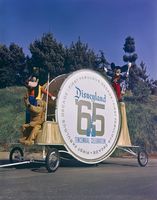
“Ten years of fantasy, ten years of fun, ten years of growing, and we’ve only just begun…” In its first decade of operation, Disneyland Park welcomed nearly 50 million guests, its attractions and shows multiplied, and its creator entertained increasingly bigger plans. The Park’s 10th anniversary in 1965—dubbed the “Tencennial Celebration”—proved a significant turning point in its history, as Walt Disney made sure it would.
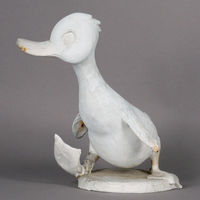
The Walt Disney Family Museum’s collection of maquettes, or small character reference sculptures, spans various Disney animated feature productions including Pinocchio (1940), Fantasia (1940), and Peter Pan (1953). While most in our collection are painted plaster, there are a few exceptions—such as this The Ugly Duckling (1939) maquette—where surfaces have been left unpainted.
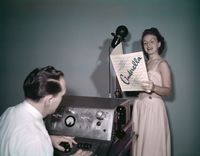
“There is a nice philosophy in Cinderella’s attitude. She can teach the young – and others – how to take adversity.” – film critic Helen Bower, April 1950
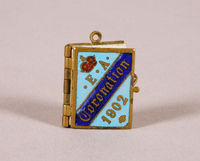
One of the objects on display in The Walt Disney Family Museum is a miniature portraiture book of King Edward VII’s coronation to the English throne on August 9, 1902. Other members of the royal family featured in the miniature book include Queen Alexandra, the Prince of Wales (later known as King George IV) and his wife Mary, and their son Edward (later known as King Edward VIII).
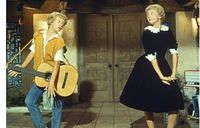
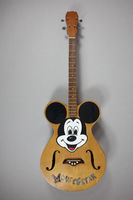
In 2019, The Walt Disney Family Museum was gifted one of two existing Mousegetars belonging to beloved head Mouseketeer Jimmie Dodd. Manufactured by Candelario Delgado of Candelas Guitar Shop, the custom-made tenor guitar was previously part of the Jimmie Dodd Archive housed at the California Institute of the Arts (CalArts) University in Valencia, CA.
With the surrender of Japan in September 1945, four years of brutal conflict for the United States during World War II finally came to end. It was at this time that Walt Disney refocused his efforts. The studio lot had been requisitioned by the U.S. military shortly after the bombing of Pearl Harbor, and in the following four years, Walt devoted over 90 percent of The Walt Disney Studios’ output to the war effort.
Released 70 years ago in 1950, Beaver Valley was the second installment in the True-Life Adventures series. As Production Supervisor Ben Sharpsteen recalled to Disney archivist Dave Smith in 1972, the film “was Walt [Disney’s] choice all over—‘We’ll make a picture about beavers.’”
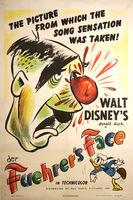
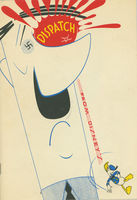
With the United States’ entrance into World War II following the attack on Pearl Harbor on December 7, 1941, propaganda became ubiquitous on the home front as the process of rallying the American war effort began. Posters of Uncle Sam and Rosie the Riveter became synonymous with the redoubtable American spirit of optimism and determination. World War II was not simply the war of the soldier, but of every man, woman, and child in the United States, and each individual was expected to do their...
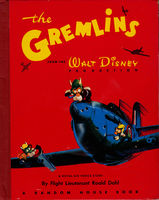
“Do you know what Gremlins are?” asked the national gossip columnist Louella Parsons in October 1942. “They are imaginary little characters who fly with the R. A. F. [Royal Air Force] pilots. They are mischievous little elves who become so real to the R. A. F. boys that they almost live and breathe.” It just so happened, reported Ms. Parsons, that none other than Walt Disney himself was planning to make a film about these little creatures.
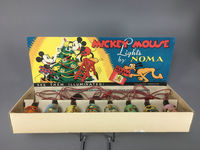
In the spirit of the season, the museum has in its collection a string of lights featuring delightful Disney Christmas artwork.
When the United States entered World War II in 1941, Walt Disney had been busy challenging commonly-held perceptions about animated cartoons. A medium once largely relegated to novelty, Disney’s animated films offered drama and pathos along with humor and song. Walt spent more than a decade elevating the art form to new levels of technique, performance, and quality. In just a few short years, The Walt Disney Studios had created multiple feature films of astounding range and style—from Snow White...